
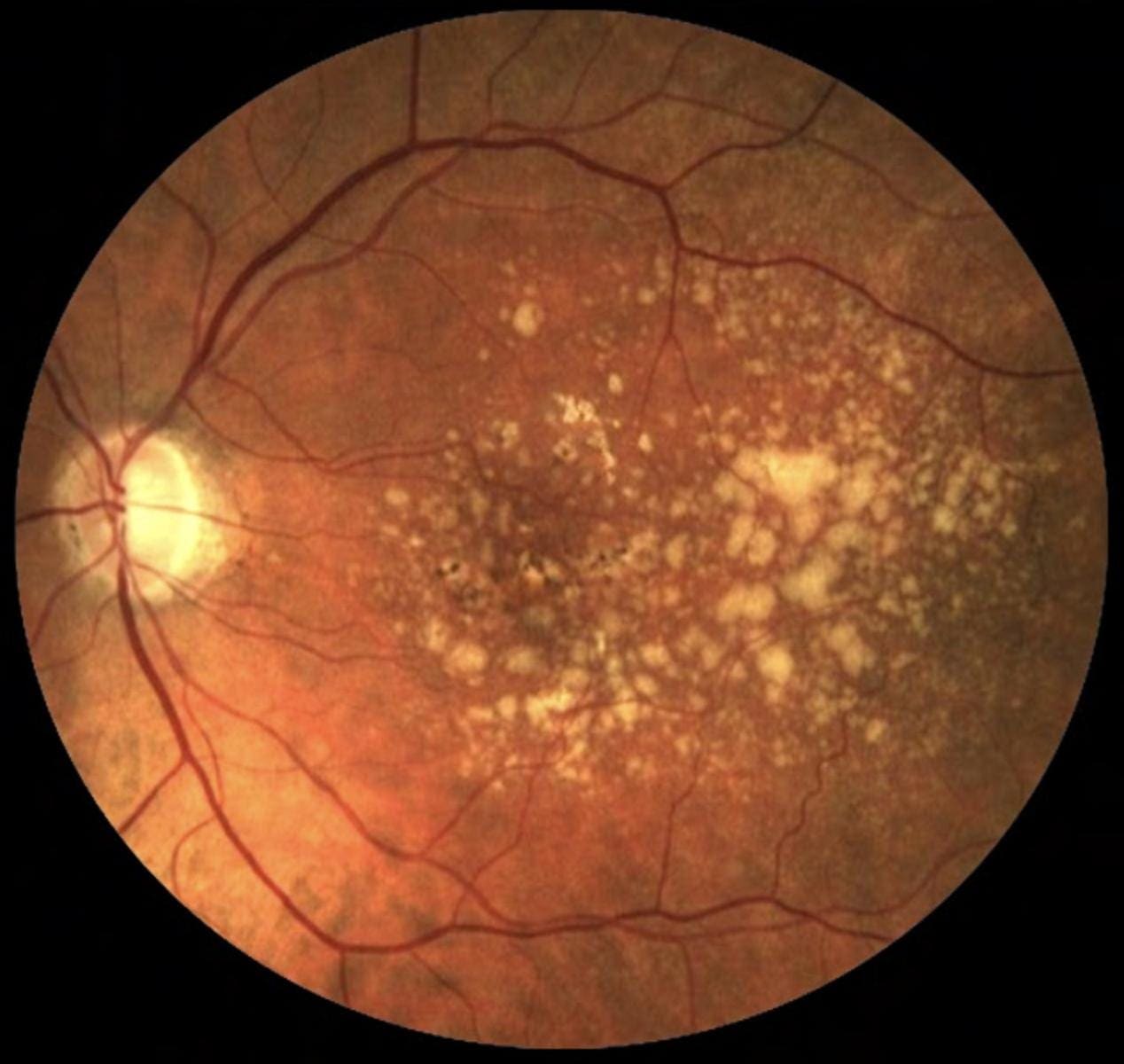
Age-related macular degeneration (AMD) is a common retinal condition that affects central vision. The macula is the central part of the retina responsible for sharp, detailed vision, which is essential for activities such as reading, recognising faces and driving. The condition mainly affects older adults and may progress gradually. AMD is classified into dry and wet forms, with the wet form potentially causing more rapid and significant loss of central vision.
Condition · Medical retina
Age-related macular degeneration
The most common macular condition
Overview
Symptoms
n its early stages, age-related macular degeneration (AMD) may cause no noticeable symptoms and may be detected incidentally during a routine eye examination. As the condition progresses, blurred or distorted central vision, difficulty reading, the need for brighter lighting and difficulty recognising faces may develop. Straight lines may appear wavy or distorted, and a dark or blurred spot may appear in the centre of the visual field.
Risk factors
The most important risk factor for age-related macular degeneration (AMD) is age, with the risk increasing significantly after the age of 50. Other factors associated with an increased risk include smoking, a family history of AMD, certain cardiovascular risk factors and environmental exposures. Having AMD in one eye also increases the likelihood of developing the condition in the other eye.
How is it diagnosed?
The diagnosis is based on a comprehensive eye examination and imaging of the macula. Optical coherence tomography (OCT) is a key diagnostic test, as it provides detailed images of the retinal layers and can detect fluid or other characteristic changes. If wet AMD is suspected, additional tests such as OCT angiography (OCTA) or fluorescein angiography may be required, depending on the individual case.
Treatment
Treatment depends on the type and stage of the disease. For wet AMD, the main treatment is intravitreal injections of anti-vascular endothelial growth factor (anti-VEGF) agents, which reduce fluid leakage and inhibit the growth of abnormal blood vessels. Treatment usually requires repeated injections and regular monitoring. For dry AMD, management mainly involves regular monitoring and addressing modifiable risk factors. Stopping smoking and adopting a healthy lifestyle are also important.
WHEN TO SEEK AN ASSESSMENT
The sudden onset of distortion of central vision, blurred vision or a new dark spot should not be ignored, particularly in people with known AMD. Prompt ophthalmological assessment is important, as the wet form can progress rapidly, and early initiation of appropriate treatment may help preserve vision. Regular follow-up is also important for the early detection of changes, even when no symptoms are present.
Key points
- Early diagnosis preserves vision.
- Modern retinal imaging provides accurate diagnosis.
- Regular monitoring is an important part of long-term care.
- Many patients with age-related macular degeneration respond well to treatment.
Read also
For assessment & monitoring.
Book an appointment for an urgent ophthalmological examination if you experience central blurring or distorted vision. Discuss the appropriate treatment approach and, if necessary, treatment with intravitreal injections.
This page provides general information only and is not a substitute for an individual consultation.