
Rhegmatogenous retinal detachment is a serious condition in which the retina separates from the underlying layers of the eye due to a retinal tear or hole. It is an ophthalmic emergency, as without prompt treatment it can lead to significant and permanent vision loss.
Surgical emergency — act the same day
Rhegmatogenous retinal detachment
Sudden threat to vision
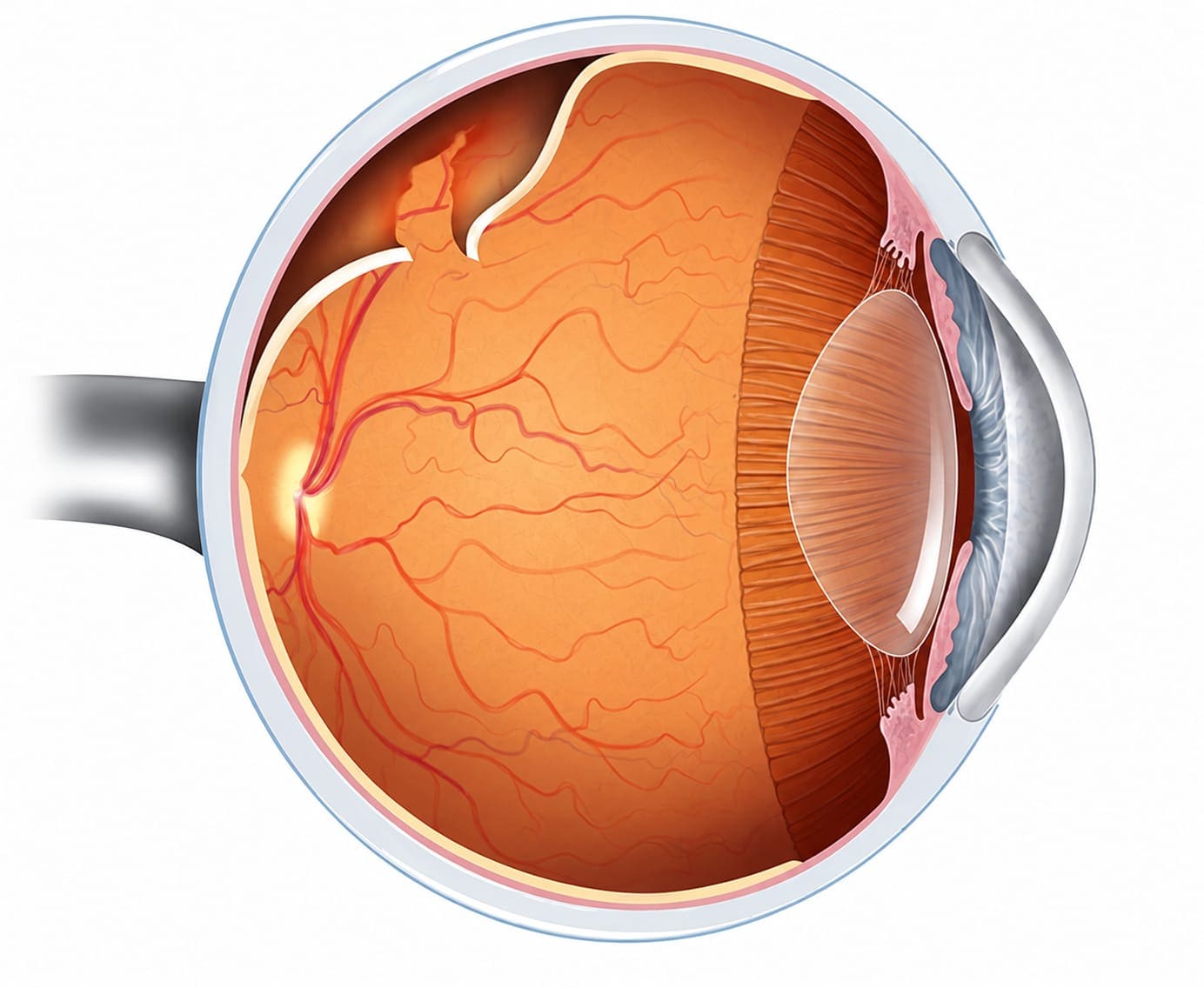
Overview
Symptoms
Retinal detachment can occur suddenly. The most common symptoms include:
- Sudden onset or sudden increase in floaters (“spots” or “flies”)
- Flashes of light or photopsias
- Appearance of a shadow or “curtain” across the visual field
- Sudden or progressive reduction in vision
- Distortion or loss of part of the visual field
The appearance of new floaters or flashes, particularly when accompanied by a shadow or “curtain,” requires urgent ophthalmic assessment.
Risk factors
The main risk factors for rhegmatogenous retinal detachment include high myopia, increasing age and posterior vitreous detachment, previous retinal detachment in the fellow eye, previous intraocular surgery, ocular trauma, lattice degeneration, a family history of retinal detachment, and certain inherited conditions, such as Stickler syndrome and Marfan syndrome.
How is it diagnosed?
Diagnosis requires an urgent, detailed examination of the retina, usually after pupil dilation. If the retina cannot be fully visualised, ocular ultrasound may be required. Wide-field retinal imaging and OCT may also be used in selected cases.
Treatment
Treatment depends on the extent and location of the retinal detachment, as well as whether the macula is affected. When a retinal tear is present without detachment, it can be treated with laser photocoagulation or cryotherapy to reduce the risk of retinal detachment.
When a retinal detachment has already occurred, surgical treatment is usually required. The main surgical options include vitrectomy, scleral buckling, or pneumatic retinopexy, depending on the characteristics of each case.
When to seek help urgently
New flashes, a sudden increase in floaters, or a dark curtain or shadow in your vision require urgent ophthalmic assessment.
Early treatment of a retinal tear may prevent a retinal detachment and can be sight-saving. Do not wait for symptoms to improve on their own.
Key points
- Retinal detachment is a serious condition that can cause permanent vision loss.
- Flashes, new floaters and a dark curtain or shadow are important warning signs.
- Urgent assessment and treatment are essential.
- Visual recovery depends partly on whether the macula is involved and how quickly treatment is provided.
Read also
Talk it through with Dr. Diafas.
For non-urgent assessment, monitoring of risk factors, or a second opinion after treatment, book an appointment. If you experience sudden symptoms, seek urgent medical attention immediately on the same day — do not use the contact form.
This page provides general information only and is not a substitute for an individual consultation.